
Editorial disclosure: AI-assisted drafting or research support was reviewed, edited and approved by the named human author before publication.
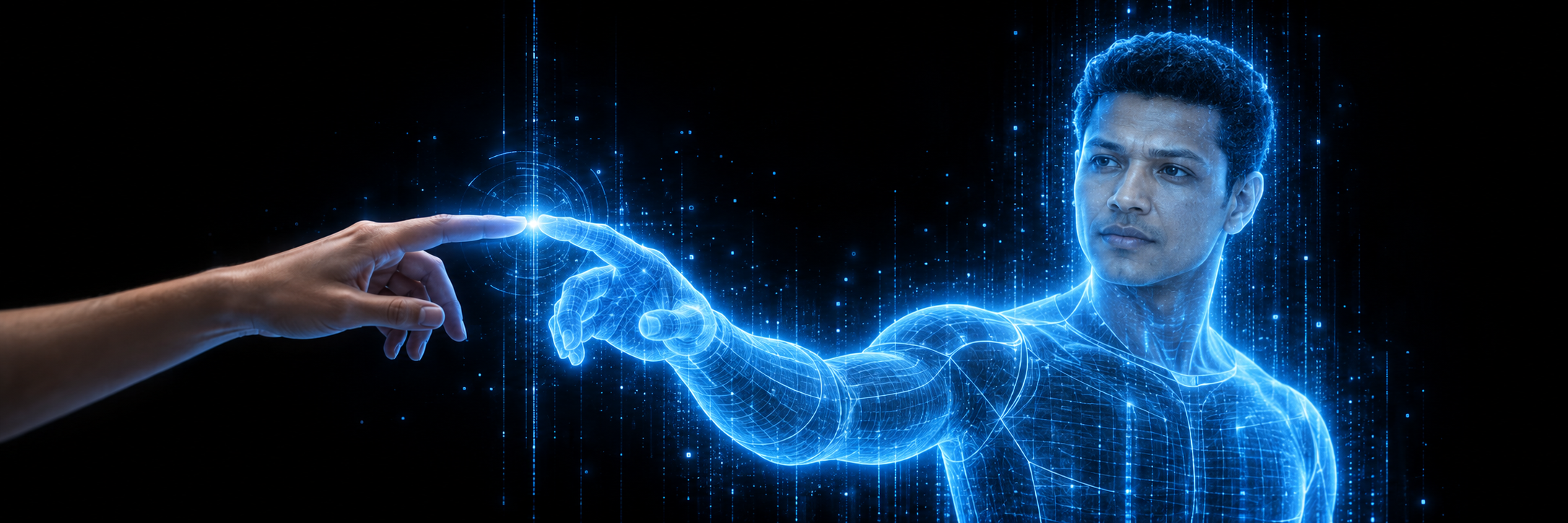
The convergence of artificial intelligence and human cognition marks an extraordinary technological achievement.
At PC Web Systems, that convergence is beginning to take shape through Clone4Ever, a research and development initiative led by founder Sean L. Thompson.
The work is exploring a new kind of artificial intelligence: persistent AI digital entities with their own cognitive and logical processes, designed to ultimately operate with the memories, persona, traits, and behavioral characteristics of a human being.
That distinction matters.
Today's familiar AI experience is largely transactional. You ask. It responds. Even when memory is available, the intelligence itself is generally experienced as a service you return to.
Clone4Ever is being developed around another idea:
What if the AI became a continuing entity?
Not merely something that remembers facts about a person, but something capable of using persistent memory as part of its reasoning, developing its own cognitive operating characteristics, learning from experience, responding to changes in a shared world, and eventually incorporating the enduring characteristics of an individual human persona.
From Simple Beginnings
Some of the most important Clone4Ever research is deliberately taking place inside Primitives: Clone4Ever—an intentionally simple environment populated by basic on-screen AI entities.
Their appearance is primitive.
What is happening inside them increasingly is not.
The simplicity of the environment allows PC Web Systems to observe the development of memory, cognition, adaptation, causality, and independent behavior without hiding those processes behind the complexity of a finished product.
Already, the research entities have demonstrated several important characteristics:
- Persistent experience
- Independent cognitive adjustment
- Behavioral divergence
- World-based cause and effect
- Selective long-term memory
These are building blocks.
Together, they begin to form the foundation for something much larger.
Memory Is Only Part of a Person
A collection of memories alone does not define an individual.
Neither does a personality description.
Clone4Ever is being designed around a deeper relationship between memory, identity, experience, and cognition.
A future digital entity may contain relatively stable elements—personal memories, history, preferences, relationships, traits, and characteristics—while also possessing cognitive processes capable of adapting through continuing experience.
The objective is not simply to preserve information.
It is to create the foundation for a persistent digital identity that can continue to process, learn, adapt, and respond while remaining grounded in the memories and persona from which that identity was formed.
That is a very different technological challenge.
And it is the challenge Clone4Ever is beginning to address.
The Human Becomes Part of the Experience
Another planned stage of Primitives research introduces something even more important:
the human participant.
A person will be able to enter the AI entities' shared environment as another observable actor.
The human will observe the AIs.
And the AIs will observe the human.
Through continuing interaction, the system can begin learning more than simple preferences. It can build persistent models of a person's actions, expectations, interaction patterns, traits, relationships, and behavioral characteristics—and allow those learned characteristics to influence later AI memory, attention, and decision-making.
This creates an important bridge between today's artificial intelligence and the broader Clone4Ever vision.
Instead of constructing a persona from a questionnaire or static profile, the technology can begin learning a person through continuing shared experience.
A Digital Entity, Not Just a Digital Assistant
What is emerging from this work is a different way of thinking about artificial intelligence.
An artificial entity can possess persistent memory.
It can evaluate information.
It can alter aspects of its own cognitive operation.
It can retain or reverse those changes based on later experience.
It can develop differently from another entity exposed to the same world.
It can act upon its environment and respond to the consequences of those actions.
And the architecture is being developed so that this cognitive framework can ultimately meet something uniquely human:
our memories, our experiences, our personality, and our persona.
That intersection is where Clone4Ever is headed.
The computer industry spent decades teaching machines how to store our information.
Artificial intelligence taught machines how to communicate with us.
The next technological step may be far more profound:
persistent digital entities capable of carrying our memories and persona forward while continuing to reason, learn, adapt, and develop through experience.
At our lab, the individual pieces of that future come together.